
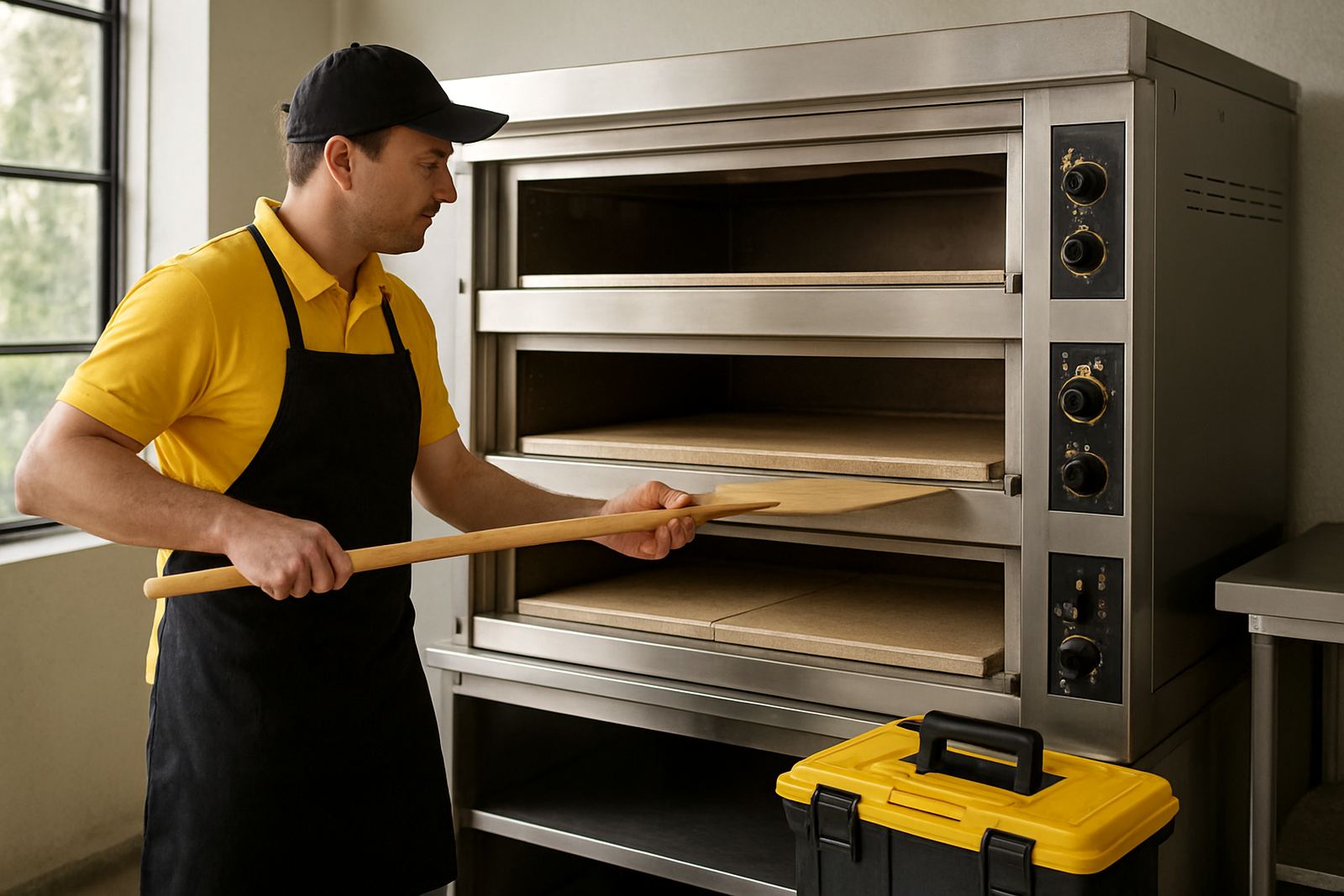
When a deck oven starts baking unevenly
A deck oven usually gives warning signs before it fails completely. You may see pale tops, burnt bases, slow heat-up after load-shedding, or one deck running hotter than the other. In coastal areas like Durban and Gqeberha, moisture and salt in the air can also affect contacts, door seals and fixings over time. In inland kitchens, the usual issue is heat stress and daily wear, especially where ovens run from early prep through to late trade.
Most calls we handle for deck ovens come down to a small group of parts. Elements lose output, thermostats drift out of range, gaskets flatten, and door latches stop closing tightly. If the oven is still usable but not consistent, it is often better to replace the failing part than to keep adjusting settings and wasting power.
Parts we match for deck ovens
Deck ovens are not all built the same, so the right part has to match the physical fit and the electrical rating. We help with part identification using model details, photos, measurements and the old part where available. If the label is unreadable, a clear picture of the mounting points, terminals or seal profile usually helps us get close quickly.
- Heating elements for single, double and multi-deck units
- Thermostats, capillary thermostats and control switches
- Door gaskets, seals and retaining clips
- Hinges, latches, handles and door springs
- Indicator lamps, selector switches and panel parts
For bakeries in Johannesburg, Pretoria and Midrand, we often work on older ovens that have had parts changed over the years, so matching by size alone is not enough. A 380 V element with the wrong length or terminal position can hold up production for days, which is why compatibility checks matter.
Planning a replacement without stopping the bake line
If a deck oven is used daily, plan the replacement around your quietest shift or a cleaning window. For restaurants, that might be early morning before prep starts. For wholesale bakeries, it may be after the last batch has cooled. The aim is to reduce downtime and avoid rushing the fit, because a rushed install often leads to a second visit.
Before ordering, check how the oven is installed. Wall clearance, access to the rear panel, and the condition of isolators all matter. If the unit sits tight against a wall, factor in enough space to remove covers and test wiring safely. Our Midrand depot supports dispatch nationwide, and for sites in Durban or Cape Town we usually advise ordering with a little lead time if the oven is already down, especially around month-end when courier volumes climb.
- Switch off and isolate the supply before any inspection
- Record the model plate, voltage and phase setup
- Measure the gasket channel and door opening, not just the old seal
- Check whether the issue is one part or a set of worn components
Common mistakes with deck oven parts
The biggest mistake is assuming a part will fit because the oven looks similar. Deck ovens from different manufacturers can use different terminal layouts, thermostat ranges and seal profiles. Another common error is replacing only the obvious failed item while leaving heat-damaged wiring, loose terminals or a warped door frame in place. That can bring the fault back very quickly.
We also see doors closing with extra force after a gasket change because the new seal is thicker than the original. That puts strain on hinges and latches. If the old seal was badly compressed, it helps to check the frame and closing alignment before fitting the new one. A minor adjustment now can save a call-out later, especialy on high-use bakery ovens.
For element faults, do not keep resetting tripped breakers without checking the load and insulation condition. If the oven trips after heat build-up, the element may be breaking down under temperature rather than failing cold.
Budget ranges for deck oven repairs
Budget depends on the size of the oven, the number of decks and whether you are replacing one item or several. A simple gasket change may sit in a lower spend bracket, while elements and thermostat work can move the total up quickly. Door hardware is often cheaper than electrical parts, but worn hinges and latches can add labour if the door needs realignment.
As a rough guide, smaller deck oven jobs can start from a few hundred Rand for minor hardware or sealing parts, while heating and control parts can run into the low thousands. A full service job that includes element replacement, thermostat checks and post-fit testing will naturally cost more. If the oven is in a busy site in Pretoria CBD or central Cape Town, allowing for after-hours access can also affect the final price.
We prefer to quote on the actual fault, not on guesswork. That keeps the spend tied to the part that is needed, rather than replacing good components just because the oven is open.
Support for bakeries, caterers and restaurant kitchens
Deck ovens are used in bakeries, hotels, school kitchens and takeaways that rely on even heat and a steady door seal. Our parts support covers national online orders, with dispatch from Midrand and coverage for Johannesburg, Pretoria, Durban, Cape Town and Bloemfontein. If you are replacing a part on a site with load-shedding backup, we can also help you think through the electrical setup so the oven does not take unnecessary strain when power returns.
The team includes Riaan Pretorius as Managing Director, Ayesha Jacobs in Operations, Sibusiso Dlamini on technical parts, Megan Naidoo in customer support, Pieter van Wyk on warehouse and dispatch, and Lerato Khumalo for field fitting coordination. That means the order does not sit with one person only. It is checked, matched and packed with the actual install in mind.
What to send us before ordering
The fastest way to get the right deck oven part is to send clear details up front. A photo of the data plate, the failed part, and the area where it fits usually helps more than a long description. If you know the model, voltage and dimensions, include them. If not, we can still work from images and measurements.
- Model and serial number if visible
- Voltage and phase details
- Photo of the faulty part from both sides
- Any notes on symptoms, for example uneven heat or door not sealing
Once we have that information, we can check compatibility and advise on the next step, whether that is an element, thermostat, gasket or door hardware replacement. For deck ovens, getting the fit right the first time saves time, food and power.